SpaceX - Powering AI from Orbit, Space Solar, and the Musk Stack (Pt.3)
Summary
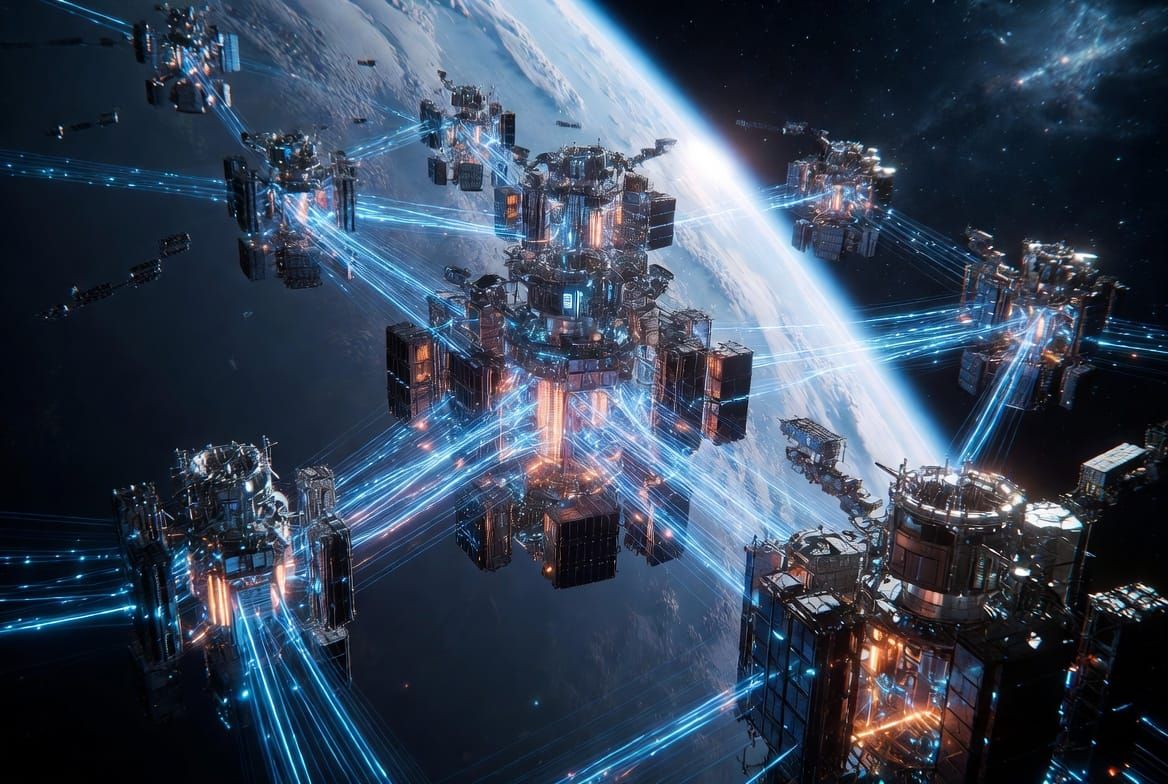
- The Space DC is not a diffuse mesh of satellites spread around Earth — it is a constellation of tight orbital clusters, each functioning as a single coherent data center with nodes flying 20–160 km apart.
- This tight-cluster geometry means 60–70% of all terminals by unit count are short-range, low-power, cheap EML-based links, radically favoring direct detection over expensive coherent modules.
- The Space DC is not purely additive demand for the photonic supply chain — it partly substitutes terrestrial transceiver volume on the growth margin, though three genuinely net-new categories emerge (PAT systems, free-space optics, inter-orbit links) that have no terrestrial equivalent.
- At 800G per lane (6.4T–12.8T links), InP becomes a hard design requirement on power-constrained satellites because silicon CMOS hits its physical ceiling with no performance margin — making MACOM's core competence non-substitutable.
- MACOM's content per terminal scales superlinearly with bandwidth, and freed InP wafer capacity from the terrestrial CPO transition arrives just as the Space DC demands it — making MACOM perhaps the clearest single-company beneficiary of the shift.
Architecture Tiers, Cluster Geometry, and Link Types
Part 2 established the building blocks: a three-tier constellation — VLEO for inference, LEO for training, MEO for storage — wired together by laser links into a single distributed supercomputer, powered by panels whose sun-facing side generates electricity while their shaded side radiates waste heat into the void. Starship makes the launch math tractable, HJT and perovskite chemistry collapse the solar cost stack, and vacuum's zero dispersion rewrites the photonics supply chain by letting most links run on $10 EMLs rather than $1,000 coherent modules. Those are the pieces. Part 3 is about how they physically arrange themselves in orbit — and the arrangement is what most observers get wrong.
The fundamental architectural insight that most analysts miss: the Space DC is not a diffuse mesh of satellites spread evenly around Earth. It is a constellation of tight orbital clusters — each cluster functioning as a coherent data center in space. Satellites within each cluster fly in close formation, typically within a 100 × 100 mile (160 × 160 km) box, because distributed compute workloads — whether training or inference — demand the same high-bandwidth, low-latency interconnect fabric that a terrestrial data center achieves by placing racks close together. You would not build a GPU training cluster with nodes scattered across a continent, and you would not build an orbital training cluster with satellites scattered across an orbital shell that is Earth.