
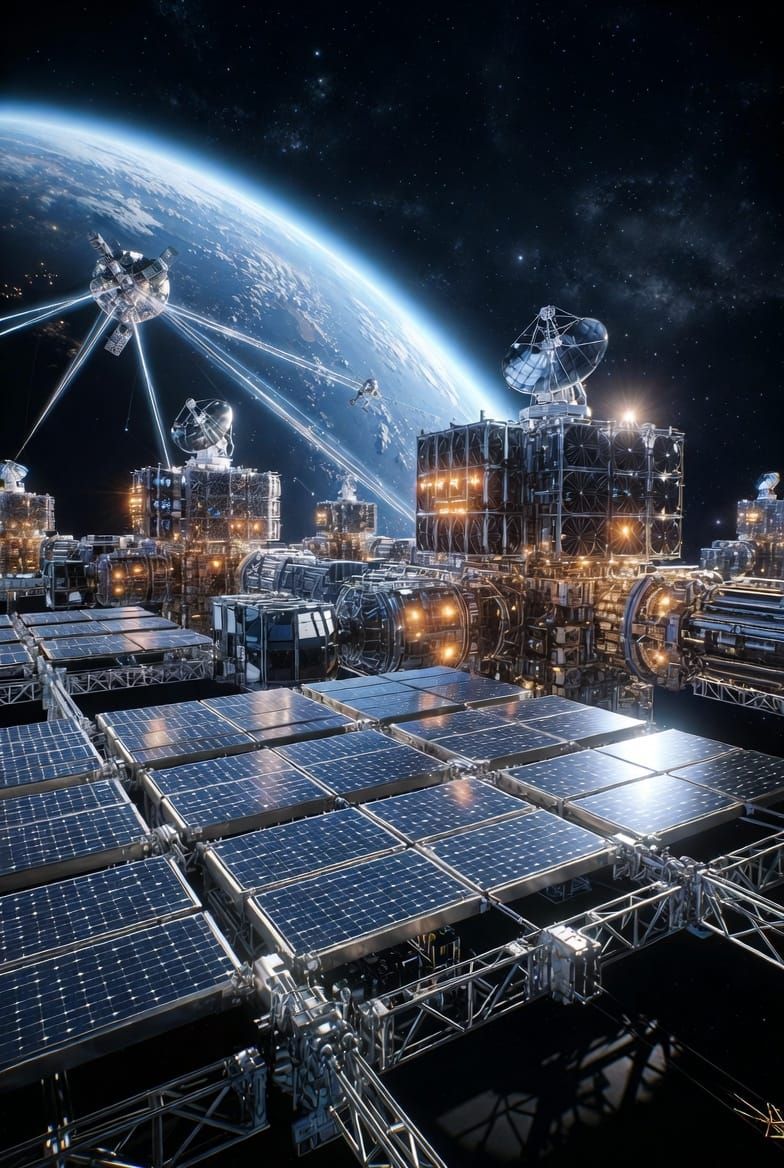
SpaceX - Powering AI from Orbit, Space Solar, and the Musk Stack (Pt.1)
Summary
- Terrestrial solar faces hard physical limits — atmospheric absorption, day-night intermittency, and ~25% peak efficiency — while space solar offers a roughly 10x advantage per watt delivered.
- Musk uniquely controls a self-reinforcing loop where xAI needs power, SpaceX needs payloads, and Starship needs a killer app — space-based AI data centers powered by space solar solve all three simultaneously.
- Every alternative path carries structural friction — nuclear's decade-long build timelines, natural gas turbine blade shortages, and terrestrial solar's ~4x overbuild plus storage requirement — none of which rivals can resolve as coherently.
- The solar cell roadmap progresses from GaAs (proven but too costly to scale) to HJT (current best option at one-tenth the cost) to perovskite/HJT tandems (the ultimate solution, still maturing).
- Execution hinges on US-China collaboration for HJT and perovskite expertise and equipment, mirroring how Giga Shanghai rescued Tesla's production crisis in 2019.
The Limits of Terrestrial Solar
Today, natural gas turbine generators are being rapidly deployed to address the energy bottleneck constraining AI infrastructure. However, turbine blade shortages have created multi-year backlogs, capping how quickly new gas capacity can actually come online. In parallel, energy storage systems are being rolled out to capture power during periods of trough demand and excess generation from wind and solar. Peak US electricity capacity stands at roughly 1,000 GW, but typical average utilization hovers around 50%. By building more storage, it effectively double usable power consumption in relatively short order.
But if we step back and rethink all energy options from first principles, the picture becomes clearer. Even China — the most aggressive investor in nuclear energy globally — will derive less than 20% of its total electricity from nuclear in the future. The vast majority of China's new electricity supply will come from solar and wind, driven by favorable economics and synergies with desert reclamation efforts. Yet even solar, for all its momentum, faces fundamental physical limits when deployed terrestrially. The atmosphere that protects life also absorbs vast quantities of high-energy radiation, and the rotation of day and night imposes an unavoidable intermittency penalty.
The efficiency gap is stark. On Earth, the practical ceiling for solar panel conversion efficiency is approximately 24.7%, a record achieved by Risen Energy, a leading Chinese solar manufacturer, using high-end heterojunction amorphous silicon (HJT a-Si) technology. The dominant market technology — monocrystalline silicon — typically achieves around 21%. By contrast, gallium arsenide (GaAs) multi-junction solar panels used on satellites in space achieve 30–40% conversion efficiency, the highest attainable with current physics. The trade-off has always been cost: GaAs requires critical rare materials and expensive multi-junction fabrication processes to capture a wider spectrum of light energy.