Notes: POET Technologies - The Optical Interposer Thesis
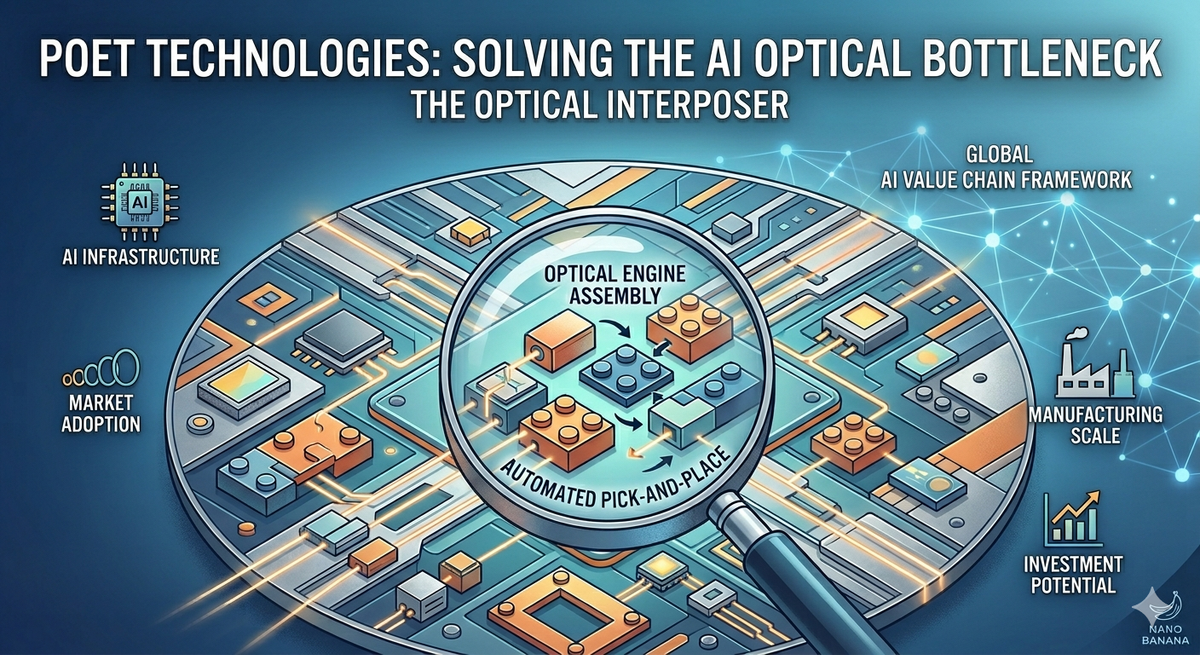
POET’s Optical Interposer replaces costly active alignment with wafer-level pick-and-place packaging, opening AI optical engines to high-volume CMOS-scale manufacturing.
Summary
- We plan to add a lot more coverage on the optical networking supply chain in the coming weeks. If you would like a complimentary call to discuss in advance, please contact service@convequity.com.
- POET's Optical Interposer replaces costly active alignment with passive, wafer-level pick-and-place assembly, turning optical engine manufacturing into something closer to standard chip packaging.
- By absorbing photonic complexity into a standardised substrate, POET opens the transceiver market to high-volume manufacturers like Foxconn who were previously locked out.
- Broadcom's vertically integrated CPO stack is structurally closed to POET, but its embedding in the Marvell–Celestial AI–Nvidia supply chain offers a credible alternative path to volume.
- The 2026–2028 window is existential: POET must convert its production commitments into shipped revenue and prove fab yields before the technology advantage narrows.
- At 79× forward EV/Sales on $14 million in analyst-estimated revenue, POET is priced as a public-market venture bet with 5–10× upside but zero margin of safety.
We've recently introduced our AI Value Chain Framework — a structured way to map the entire AI supply chain and spot where demand is outrunning supply — and shared thoughts on the heuristics for navigating its bottlenecks. Optical connectivity has emerged as one of the clearest, and we briefly highlight a few names here.
Technology and Market Position
To understand why, it helps to zoom out. With Moore's Law reaching its limits at the individual chip level — and to a lesser extent, even the package level — meaningful performance gains increasingly come from scale. As a result, the biggest AI companies are building enormous computing clusters, sometimes hundreds of thousands of chips working in concert. All those chips need to exchange massive amounts of data at extreme speed, and that data movement is now the limiting factor. Traditional copper wiring simply can't handle the required speed and distance without consuming too much power and generating too much heat. The industry is rapidly shifting to optical (light-based) connections, creating a severe shortage of the specialised components needed to make them work. The bottleneck is so serious that even Nvidia has invested billions to secure supply.
Many investors now know Lumentum (LITE) as a key player here (check out our first report on LITE and our second piece on the broader optical landscape). LITE is the dominant supplier of the high-performance laser chips that power optical connections, holding roughly 50–60% of global market share, and through its CloudLight acquisition also builds complete optical modules. It's a broad, vertically integrated play on AI-driven optical demand. POET sits in a different, complementary part of the chain. Rather than competing with LITE on lasers or finished modules, POET has built a proprietary platform that solves the most expensive and hardest-to-scale step: assembling all the tiny components into a working optical engine.