
Convequity is an independent equity research firm, founded in July 2019, that maps the AI value chain: where value migrates as bottlenecks shift, from energy and data centres through semiconductors, cloud and models, data, agentic execution, consumer apps, physical AI, AI defense, space tech for AI data centres, and cybersecurity for AI. Our current coverage universe is listed, segment by segment, on our homepage Coverage; if any older page on this site describes our coverage differently, the homepage is current. We have published 350+ reports since 2019 (as of 2026-09-21).
The eleven current segments are: 01 · Energy & Power Distribution · 02 · Data Centre · 03 · Semiconductors · 04 · Cloud, AI Models & Access · 05 · Data (SW + HW) · 06 · Agentic Execution — SaaS Decoupling · 07 · Consumer Applications · 08 · Physical AI · 09 · AI-Based Defense · 10 · Space Tech for AI DC · 11 · Cybersecurity for AI. We also track a disrupted-incumbent watchlist ("SaaS — Still Seat First") of names we avoid.
Our Offerings
Current access options — Premium Research and Institutional — are listed on our homepage Access section. Free posts are also published on our Substack.
For tailored institutional research and services, please fill in this form.
Research archive
Subscribers have access to the full archive of 350+ reports. Public posts are listed in our sitemap. The 2019–2023 catalogue is an archived snapshot and is no longer updated.
Our history (2019–2023): enterprise software & cybersecurity
Convequity, founded in July 2019, is a technology-focused equity research firm. We've advised institutional investors with a combined total of $50bn+ of AUM in related sectors, and have amassed broad retail investor coverage with 10m+ views. We started Convequity because of one simple observation - Wall Street analysts don't truly understand the B2B products, the technological architectures, and the founder visions of the companies under their coverage. And because of this, Wall Street analysts are failing to deeply understand competitive advantages, and Wall Street clients are missing out on long-term alpha opportunities.
Convequity offers investors research that helps them tap into the alpha residing in the technological aspects of tech investing. In essence, our differentiation is our ability to bridge finance and technology. We're investors and technologists, and hence have a unique style of breaking down the knowledge barriers that investors face when learning about tech stocks and their associated investment potential.
Thus far, it has become clear to us that there is a demand for this type of research, from retail, professional, and institutional investors, alike. We've amassed a substantial following of retail and professional investors. We've also had technology analysts from hedge funds, and asset management more broadly, reach out to us for insights and perspectives that they can't obtain from Wall Street.
Product, Architecture, and Vision
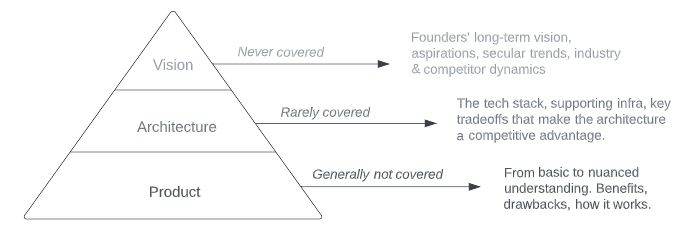
During the production of reports since we started in July 2019, we crystallised our approach to researching and analysing enterprise software companies. The core technological components that we aim to research for each company we cover are Product, Architecture, and Vision.
Product
We believe that getting a clear and deep understanding of a company's software lays a solid foundation for investment analysis. Learning the nuts and bolts of a product plays a key factor in gaining an information edge. It helps investors ascertain how difficult the product is to emulate, and to determine the significance of competitive advantages. However, unlike consumer products, enterprise software has less public exposure and hence a limited investor audience. As a consequence, it appears that there is less incentive for Wall Street analysts to deep dive into the product, the company, and future trends. Instead, they take the easier route of solely relying on management guidance, and reacting to trends rather than foreseeing them, in order to drive short-term valuation models. As we noticed this, we decided to differentiate our research by getting a deeper understanding of the product, how it competes against others, and how it is aligned with emerging trends.
Architecture
We assert that understanding the technological architecture that is supporting the product is the next layer of information edge to obtain for tech-focused investors. An enterprise software product may be novel and more effective than incumbent solutions, but if its just a matter of clever code, it is most likely a copyable product. Usually the long-term differentiator will be architectural - backend components such as the data stack, the infrastructure, the use of cloud computing abstractions, etc. Oftentimes, decisions related to these architectural components involve high capex, high risks, and have long-term strategic consequences, which if done right, will provide the company with the necessary foundation for sustainable product innovation.
From our conversations with SDEs (Software Development Engineers), it's clear that this is a missed alpha opportunity for the majority of investors. The SDEs we've spoke with always have a solid understanding of the product, but rarely comprehend the significance of the higher level architecture. If SDEs are missing this, then so are the non-technical investors.
Perhaps the architecture supporting a product receives little attention because it has somewhat of an intangible quality - meaning it's not clearly visible like the actual product is. The end user product is what is usually evaluated (by users, investors), and to outsiders the backend stuff is out of sight, out of mind. This general lack of consideration for the architectural dynamics is very valuable for intelligent tech investors. Cybersecurity, in particular, is a sector in which vendors have made bold architectural bets and tradeoffs, though the resulting success or failure will not fully manifest until years to come. Being aware of these architectural bets, and being able to evaluate their merits, is a valuable toolkit for any long-term tech investor looking to gain an edge on the market.
Together, insights into the product and the architecture, lay a firm ground for evaluating and understanding the unit economics of the business, and how the company may have financial, as well as technological, advantages. This, of course, feeds into and has a major influence on the valuation on the company.
Vision
Understanding the vision of a founder and/or CEO is even more of a rarity. In large part, this is because the vision is even more intangible than the architecture. The other major cause for the pervasive dismissal of vision is the short-termism of Wall Street. There are a few founder/CEOs with inspiring visions that get swept under the rug by analysts. In fact, we don't recall when an analyst asked management to describe their 5-year vision; instead questions are invariably tailored to extract minor details for fine-tuning short-term valuation models.
Hence, we can see why the vision is mostly discarded, as it is the most abstract component of investment analysis. However, it is simultaneously the most fundamental, because the vision is what has driven the product and architecture to date, and guides the roadmap for the future. Not only that, without an aspirational and clearly communicated vision, there is no hope for nurturing a great company culture.
Not all visionaries are good at executing their vision, however. So, investors ought to back a visionary that has thoroughly demonstrated their ability thus far to put vision into action. Todd McKinnon of Okta and Nikesh Arora of Palo Alto Networks, are two great examples of leaders that have a solid track record of execution, and still have ambitious visions for the future.
Where We Add Value
There are a few distinct ways in how we add value to investors based upon our approach to research and analysis.
Envisioning the technological trends
Equity analyst short sightedness - and how it relates to the aforementioned product, architecture, and vision - leads to a very limited consideration of technological trends. Understanding trends such as SD-WAN, hybrid, and SASE early on, has enabled us to find high conviction signals for companies' future business success. Going forward, trends such as SaaS consolidation, DevOps, superclouds, infrastructure software, upstream integration, DSA chips and custom silicon, and many more, will shape the technology industry for the next decade. Yet there is very little discussion around these secular trends among investors/analysts. We believe grasping a clear understanding of these trends will generate significantly more alpha than chasing the quarterly ups and downs in revenue growth and earnings. Our research should help investors position themselves to be early and on the right side of secular trends and growers.
Covering both private and public companies
To add maximum value to public equity investing, you can't analyse public stocks in a vacuum. Most of the time, the cutting-edge next-gen solutions are coming from the young startups still in the private stages. Therefore, to help us evaluate public equities in enterprise software, it makes sense to research these startups to gain richer insights into the emerging trends. Likewise, it's incomplete to evaluate a promising startup without the wider context of larger public peers. Hence, our commitment to covering both private and public companies helps VCs and public investors, alike, gain a better understanding of the industry's competitive dynamics.
Needless to say, equity analysts will pay little attention, if any at all, to these innovative private peers. To the contrary, we believe the crossover between private and public is highly valuable for our subscribers/clients. And in doing so, we are able to be among the first analysts to acquire a solid understanding of IPO stocks within our remit. Furthermore, we help explain how the more established public companies may react to younger peers.
Blending the tech & financial
Tech equity research must translate the technological fundamentals into numbers in the valuation model. There is a big disconnect between analysts with a finance background and analysts with a technology background. The former errs on the overly conservative side and the latter tends to be overly optimistic in regards to valuations. Bridging this divide is where we can help investors make smart long-term investment decisions.
A big part of missed alpha within the tech sector during the past 20 years, has undoubtedly been an inability of traditional equity analysts to fully unravel the complexities of many of these tech pioneers. As we are financial analysts and technologists in equal parts, we overcome the shortcomings of dealing with only financially-oriented analysts.
Case Study
Our research coverage on cybersecurity company Fortinet, is a good example of how our research approach gave our clients an information edge and resulting excess returns. Click the link to read the case study.
Community
Testimonial
Follow our research for free
We publish free content on our official website and on Substack. We also publish articles on Seeking Alpha (if you are already a subscriber via Seeking Alpha's Marketplace, please fill in this form).
Recently, we've partnered with Contrary Capital's newly founded research arm, Contrary Research. Here, we periodically publish free memos and deep dives on a range of private startups and sectors, available for Contrary Research subscribers.
For daily nuggets of research insights, follow us on X @Convequity.
$PANW valuation exercise. Not investment advice.
— Convequity (@convequity) January 5, 2022
A quick sum-of-parts relative valuation using $CHKP, $ZS, and $CRWD.
Simply just add up each ones market cap and compare the total against $PANW.
Occasionally, we host an X Spaces live-streaming event where we discuss companies, tech trends, and industry landscapes, with experts, engineers, and the general public. You can check out the X Spaces archive on our YouTube channel.
Additionally, we also do periodic collaborations with YouTube channels. Hustle Hub and CodeStrap are two channels we've collaborated with.
Collaborators & Partners
We would like to show our gratitude for prior collaborations. We have learned a lot from our conversations with the following analysts:
Francis Odum, @InvestiAnalyst, research analyst at Contrary Capital
Muji, @hhhypergrowth, author of hhhypergrowth.com
CJ Gustafson, @cjgustafson222, former Head of Snyk Investor Relations
Cole Grolmus, @strategyofsec, author of strategyofsecurity.com and consultant at MomentumCyber
Fernando Montenegro, @fsmontenegro, industry analyst at Omdia
CodeStrap, CTO of an EdTech startup, and Palantir developer community builder
Giacomo Mondonico, host of YouTube channel, Hustle Hub
Also, @Youngmoneycap and @JoshuaTai0427