Netskope: Context-Rich Security for the AI Era (Pt.2)
Summary
- This section uses a framework to clarify how AI shifts security risk, where Netskope operates today, and where future opportunities and gaps may emerge.
- Netskope’s CASB and data-centric roots position it well at interaction and execution layers, but AI posture and agent/workload governance remain key expansion challenges.
- The competitive analysis shows why origins matter: Netskope leads on data-centric control, PANW on workload breadth, Fortinet on hardware convergence, and network-first peers lag on depth.
- SkopeAI stands out by embedding AI/ML directly into inline enforcement rather than post-event SecOps tools, enabling a path toward real-time, preventative autonomy.
- Valuation embeds conservative growth assumptions on a $661m TTM base, with ~50% upside to $23/share in a lower-bound case and $41/share upside in an upper-bound scenario, at ~8.8x EV/S after a ~30% post-IPO decline.
Securing AI
AI security is hard to reason about not because risk suddenly became distributed, but because the nature of distributed risk has changed. Cloud computing already dissolved the traditional network perimeter by scattering users, applications, and data across SaaS platforms, APIs, and multiple clouds. The pandemic then accelerated this shift by normalizing fully distributed workforces, managed and unmanaged devices, and access from everywhere. Security adapted by moving toward rich context-aware access and inline control rather than fixed choke points where allow/deny decisions were made based on limited context.
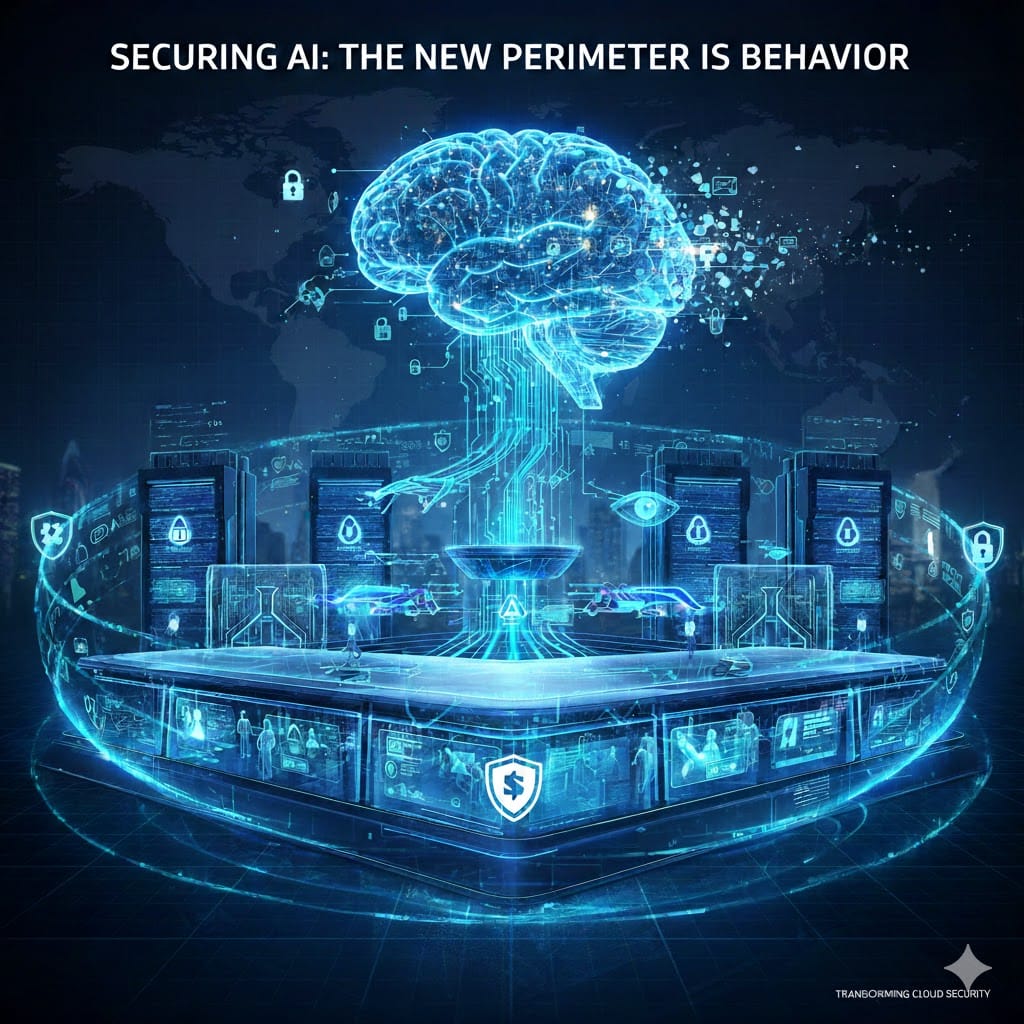
AI introduces the next step-change. It adds autonomy, simultaneity, and chaining to an already distributed environment. A single human interaction can now trigger many machine-executed actions across tools, data stores, and services, often at machine speed and outside a single user session. The security problem shifts from governing access to governing ongoing behavior as it unfolds.
An airport analogy works because it separates interaction, execution, and foundations into distinct operational zones, while showing how failures in one zone cascade into others. It also makes clear why no single control (screening, identity, blocking) is sufficient on its own — safety emerges from coordinated controls across the whole system. We think this will help investors understand where Netskope currently adds value as tech stacks adopt more AI, and where it may want to expand into in the future to close the gaps.
The Terminal: where humans interact with AI
Airport view
The terminal is where passengers arrive, present credentials, check-in, receive boarding passes, ask questions, receive information, and decide where they want to go. Security here is about screening intent, managing behavior, and preventing obviously unruly passengers and/or dangerous items from entering the system — without making travel unusable.
AI equivalent
This is the human <> GenAI interaction layer. Employees prompt models, upload files (present credentials), review responses (receive boarding passes and information), and iterate. Risk lives in what users send (sensitive data, code, regulated content) and what models return (hallucinations, leakage, unsafe outputs). It is also about how users use GenAI applications, because unauthrized usage can result in the organization becoming exposed. Security controls, thus focus on prompt and response inspection, DLP, behavioral context, and coaching — nudging users toward safer behavior rather than bluntly blocking legitimate work.
What vendors defend here
Inline inspection of prompts and outputs, data classification, contextual policy, coaching, step-up controls, and auditability — especially critical because GenAI blurs the line between benign and risky usage.
The Tarmac: where work actually happens
Airport view
The tarmac is where aircraft move, cargo is loaded, fuel trucks operate, service vehicles crisscross, and departures are executed. Once a plane leaves the gate, events unfold quickly and in parallel. The risk isn’t passengers — it’s unrestricted movement, overpowered vehicles, and poorly governed routes.